
Using AI to Identify Errors in Driver Qualification Files Before DOT Audits
CDLSuite
DOT compliance is not just about having driver qualification files in place—it’s about ensuring that every document within those files is accurate, complete, and up to date. For many fleets, this is where the real challenge begins. Even when documents are collected and organized properly, small errors such as missing signatures, incorrect dates, or inconsistent information can lead to violations during an audit.
In practice, these issues are extremely common. Many files appear complete at a glance but contain small gaps that are easy to overlook—especially when managing dozens or hundreds of drivers. A missing signature on a medical certificate, a date entered incorrectly, or a mismatch between a license and system record can all create compliance exposure.
These are not typically the result of negligence. More often, they occur because of the sheer volume of documentation that must be reviewed and maintained across a fleet. Human review alone, while necessary, is not always sufficient to catch every detail.
This is where artificial intelligence is beginning to play a meaningful role in DOT compliance.
AI-assisted document review introduces a new layer of oversight by analyzing driver qualification file documents as they are uploaded and maintained within the system. Instead of relying entirely on manual checks, fleets can now use technology to continuously review documents for potential issues.
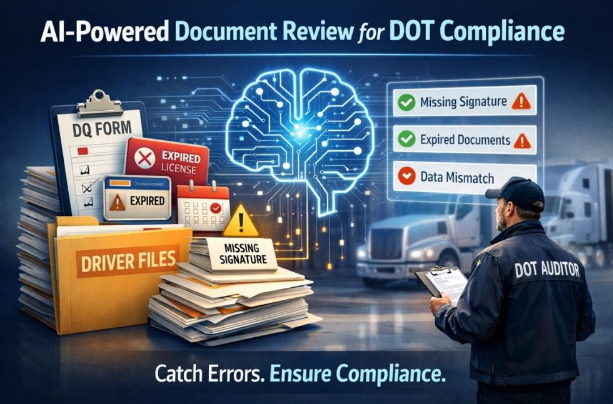
One of the most immediate benefits is the ability to detect missing or incomplete information. Documents that lack required signatures, contain blank fields, or are otherwise incomplete can be flagged automatically. These are common issues that can easily be overlooked during manual review, especially when teams are working quickly or handling large volumes of files.
AI can also identify problems related to dates, which are a critical component of compliance. Expired medical certificates, outdated licenses, or missing expiration fields can all result in violations if not addressed in time. By automatically extracting and evaluating date information, AI helps ensure that time-sensitive documents remain valid and properly tracked.
For example, a medical card may be uploaded with an expiration date that differs from what was entered into the system, or a license may appear valid in a spreadsheet but is actually expired on the document itself. These are the types of inconsistencies that often slip through manual review but can be identified quickly with AI-assisted analysis.
Another important capability is the detection of inconsistencies between documents and system records. If a driver’s name, license number, or other identifying information does not match across documents, the system can flag the discrepancy automatically. While these mismatches may seem minor, they can raise red flags during audits and require additional time to investigate and resolve.
What makes AI particularly valuable in this context is its consistency. Unlike human reviewers, who may become fatigued or overlook details when reviewing large numbers of documents, AI applies the same level of scrutiny to every file. It does not skip steps, and it does not rely on memory or interpretation in the same way a person might.
This does not eliminate the need for human involvement—it enhances it. Compliance teams can focus their time on resolving flagged issues rather than trying to identify them. In many cases, this shifts the role of the user from “searching for problems” to “managing and resolving them,” which is a much more efficient use of time.
In the context of driver recruiting and onboarding, AI-assisted review can also improve the quality of incoming documentation. As applicants submit forms and supporting documents, issues can be identified early in the process. This reduces onboarding delays and helps ensure that new hires meet compliance requirements before they are brought on.
For fleets preparing for a DOT audit, the impact of this approach can be significant. Instead of conducting a last-minute review of driver files, companies can maintain a continuous state of compliance. Issues are identified and addressed as they occur, reducing the risk of violations and eliminating the need for rushed corrections.
The shift toward digital driver files has already transformed how fleets manage compliance, replacing paper-based systems with centralized, accessible records. The addition of AI takes this a step further by making those systems intelligent. Rather than simply storing information, the platform actively works to ensure that information is accurate, complete, and compliant.
CDL Suite’s approach is designed with usability in mind. The system requires little to no training and integrates seamlessly into existing workflows, making it accessible for both experienced compliance professionals and teams without dedicated safety personnel. Combined with real-time alerts and live support, it provides a practical solution for maintaining driver file compliance at scale.
As regulatory requirements continue to evolve and the volume of documentation increases, relying solely on manual processes becomes increasingly difficult. AI provides a practical way to manage this complexity, offering a level of detail and consistency that supports stronger compliance outcomes.
For companies managing driver qualification files, the goal is not just to store documents— but to ensure those documents meet regulatory standards at all times. AI-powered DOT compliance software helps close that gap, transforming compliance from a reactive obligation into a proactive, continuously monitored system.
Learn how CDL Suite helps automate DOT compliance and monitor driver qualification files in real time.
Get started IN MINUTES
Starting at only $199.95 /month
Nothing to download or install. CDL Suite is web-based so there are never any compatibility issues. No need to purchase any hardware or software. Driver qualification file software could not be easier.
Get Started


