
CDLSuite
Managing Driver Qualification Files has changed considerably from the days of paper folders, spreadsheets, shared drives, and calendar reminders. Today's DQ file software can help employers collect driver documents, track expiration dates, identify missing records, manage onboarding, order screening reports, and maintain audit-ready files.
But DQ file systems are not all designed for the same type of organization.
Some platforms are built around high-volume driver recruiting. Others are part of much larger fleet-management systems covering vehicles, hours of service, ELDs, safety, and other operational functions. Still others combine software with outsourced compliance services.
The best DQ file software is therefore not necessarily the system with the longest feature list. It is the platform that best matches how your organization hires drivers, manages compliance, and operates its fleet.
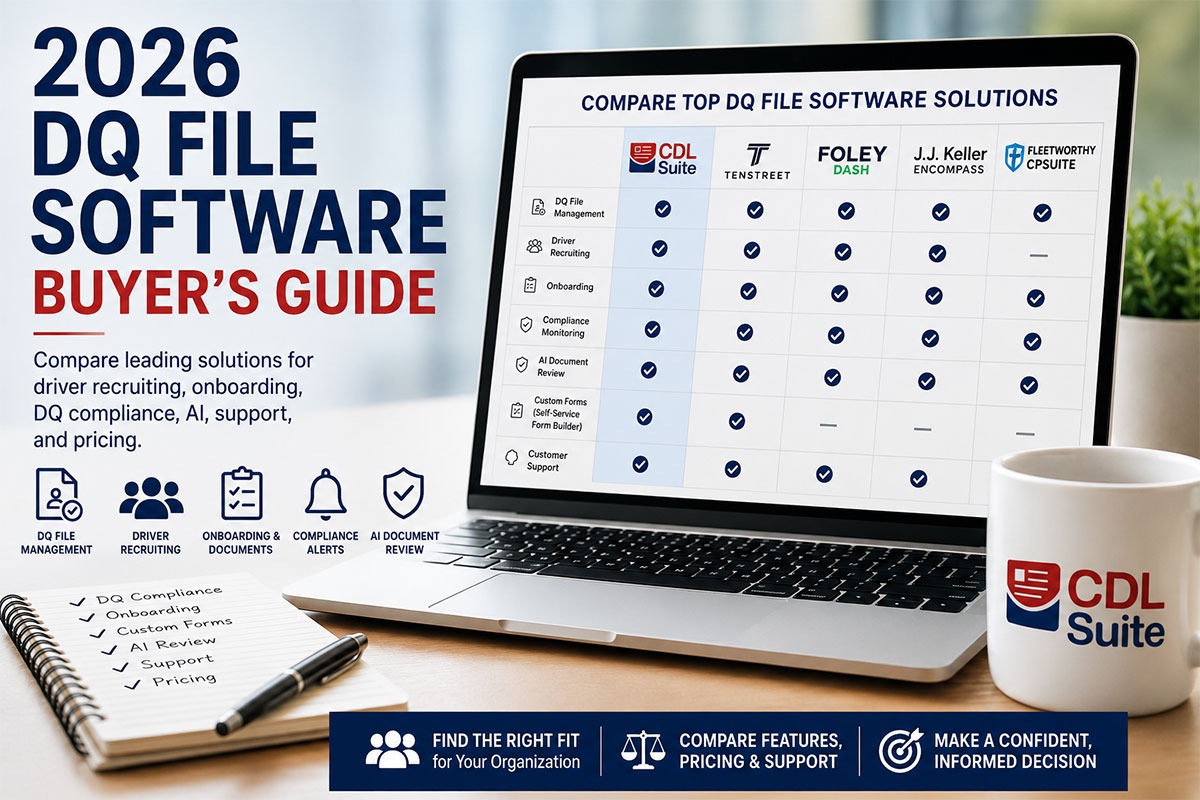
This guide compares five established options: CDL Suite, Tenstreet, Foley Dash, J.J. Keller Encompass, and Fleetworthy CPSuite.
Which DQ Software Is Best?
The answer depends largely on the problem your organization is trying to solve.
CDL Suite is a strong fit for organizations seeking a straightforward platform centered on driver recruiting, onboarding, and ongoing DQ file compliance without requiring a broader fleet-management ecosystem.
Tenstreet is particularly strong for commercial carriers with substantial and continuous driver recruiting needs. Its Driver Pulse network and extensive recruiting ecosystem can be especially valuable to carriers that continuously need to attract and hire drivers.
Foley Dash combines DQ compliance technology with extensive screening, drug and alcohol testing, monitoring, and compliance services, making it attractive to organizations that want both technology and hands-on compliance support.
J.J. Keller Encompass provides broad regulatory and fleet-management capabilities extending well beyond DQ files into areas such as hours of service, vehicle maintenance, training, drug and alcohol program management, and other fleet-compliance functions.
Fleetworthy CPSuite is oriented toward comprehensive fleet safety and regulatory compliance, combining driver qualification management with vehicle, safety, licensing, permitting, and other compliance functions.
The right choice depends on whether your primary need is driver recruiting, DQ compliance, outsourced compliance support, or broader fleet management.
What Is DQ File Software?
Driver Qualification File software helps employers create, organize, monitor, and maintain the records required to demonstrate that commercial drivers are properly qualified.
Instead of relying on paper files, spreadsheets, shared drives, and manual reminders, electronic DQ systems centralize driver records and help administrators identify missing, incomplete, or expiring documents.
Depending on the platform, DQ software may also include electronic driver applications, consent forms, electronic signatures, previous-employer verification, background screening, Motor Vehicle Records (MVRs), drug and alcohol compliance, automated reminders, document review, and driver onboarding.
The result should be more than an electronic filing cabinet. A good DQ management system should help an employer know which drivers are compliant, which files require attention, and what needs to happen next.
What Should You Look For?
Before comparing vendors, determine which capabilities actually matter to your organization.
DQ File Management
At minimum, the system should provide centralized electronic driver files and make it easy to identify required, missing, incomplete, and expiring documents.
The objective is not simply to digitize a filing cabinet. Administrators should be able to determine the status of their driver files quickly without manually opening and reviewing every document.
Electronic Driver Applications
For employers hiring new drivers, the DQ process begins before the employee's first day.
A DOT-compliant electronic driver application can reduce duplicate data entry and allow information collected during recruiting to flow directly into screening, onboarding, and ultimately the driver's DQ file.
Recruiting and Applicant Management
Not every organization needs the same recruiting capabilities.
High-turnover for-hire carriers may place enormous value on continuously sourcing large numbers of driver applicants. A private fleet, municipality, construction company, utility, distributor, or service organization may already generate sufficient applicants and instead need a better way to evaluate, process, and onboard them.
Understanding which problem you have is important when selecting software.
Driver Onboarding
Look for the ability to distribute forms electronically, obtain signatures, collect documents from mobile devices, and automatically organize completed records.
Reducing the number of manual steps between application and hire can shorten onboarding time while reducing administrative work and compliance errors.
Custom Forms
Commercial driver employment and compliance require numerous forms, acknowledgments, authorizations, and signatures. Collecting them can be especially challenging because drivers frequently work away from an office.
Most modern platforms support electronic forms and signatures. An important distinction is whether your administrators can create and modify their own forms or must ask the software provider to configure them.
If your organization frequently uses company-specific safety forms, policies, acknowledgments, equipment forms, or other documents, ask whether authorized users can turn those documents into mobile-ready electronic forms themselves, add required fields and signatures, and distribute them directly to drivers.
Also ask whether vendor assistance or additional fees are required each time a new form is needed.
Alerts and Compliance Monitoring
DQ software should proactively identify documents that are missing or approaching expiration.
More advanced systems may notify drivers directly, monitor MVR activity, identify compliance deficiencies, and provide dashboards showing file status across the organization.
Screening and MVR Integration
Organizations that order MVRs, PSP reports, CDLIS records, criminal searches, or other screening products should determine whether those services can be initiated from within the platform and whether results flow automatically into the driver's record.
AI Document Review
Artificial intelligence is increasingly being incorporated into DQ management.
Rather than relying entirely on a person to open every document and inspect it manually, AI-assisted systems can analyze documents and flag records that may require human attention.
AI should complement - not replace - qualified compliance personnel. Its value is helping administrators identify potential problems faster and focus their expertise where it is most needed.
Integrations
Consider where driver information originates and where it ultimately needs to go.
Organizations using HRIS, ATS, payroll, telematics, safety, or other business systems should determine which integrations or APIs are available and exactly what information can move between systems.
Ease of Use
More features are not always better.
A platform with hundreds of capabilities may be ideal for an organization that needs them. For another company, that same breadth can create unnecessary complexity.
During a demonstration, ask the vendor to show how an administrator completes routine tasks - not simply the platform's most impressive features.
A useful question is:
How much training will a new HR, recruiting, or safety employee require before becoming comfortable with the system?
Customer Support
Support can become especially important when software is being used to manage regulated driver records.
Ask prospective vendors:
- Is live customer support included?
- Is telephone support available?
- What are the support hours?
- Is support primarily technical, or is compliance assistance available?
- Is implementation assistance included?
- Is formal training required?
- Are there additional fees for implementation, training, or enhanced support?
Do not assume every provider uses the same support model.
Pricing and Contracts
Ask for the total expected cost rather than simply the advertised base price.
Pricing may depend on fleet size, active drivers, selected modules, screening services, implementation, integrations, or additional services.
Also determine whether the agreement is month-to-month or requires a longer-term commitment.
Best DQ File Software in 2026
CDL Suite
Best for streamlined recruiting, onboarding, and DQ compliance
CDL Suite is designed around the employment and compliance lifecycle of commercial drivers: application, screening, onboarding, hiring, and ongoing Driver Qualification File management.
The platform provides electronic driver applications and consent forms, electronic signatures, customizable DQ files, alerts and reminders, integrated background screening, and ongoing compliance management.
CDL Suite also incorporates AI-powered document review designed to identify missing information, signatures, expiration dates, and other potential document deficiencies, helping administrators focus their attention on records requiring follow-up.
A significant part of CDL Suite's approach is simplicity. Organizations do not need to deploy an ELD, telematics, toll-management, or comprehensive fleet-operations system simply to manage driver recruiting and DQ compliance.
That can make CDL Suite particularly attractive to private fleets and organizations that employ commercial drivers but are not primarily trucking companies, including municipalities, utilities, construction companies, distributors, manufacturers, passenger carriers, and service fleets.
Self-Service Form Builder
One notable CDL Suite capability is its self-service Custom Form Builder.
Authorized users can create mobile-ready electronic forms for their organization, determine what information drivers must provide, add signature requirements, and send those forms to drivers for completion on virtually any device.
This is particularly useful for organizations that regularly create their own safety acknowledgments, company policies, equipment forms, authorizations, or other documents requiring a driver's signature.
Rather than waiting for the software provider to create or modify a form, administrators can manage the process themselves.
Organizations comparing platforms should specifically ask other providers whether equivalent self-service form creation is available or whether custom forms require vendor configuration.
Pricing and Support
CDL Suite publicly publishes starting pricing of $199.95 per month.
Subscriptions are month-to-month with no long-term contracts, and free phone support is included. CDL Suite also provides compliance support and is designed to require little training or setup.
Best fit: Organizations seeking an approachable, customizable system focused on recruiting, onboarding, and DQ compliance without requiring a large fleet-management ecosystem.
Tenstreet
Best for high-volume driver recruiting
Tenstreet provides one of the transportation industry's most extensive driver recruiting and driver-lifecycle platforms.
Its products span driver recruiting, applications, screening, employment verification, onboarding, DQ file management, safety, communication, training, and retention.
A major differentiator is Driver Pulse, Tenstreet's driver-facing career application.
Drivers can maintain their information, communicate with carriers, upload documents, complete onboarding activities, search available jobs, and apply for employment opportunities. Participating carriers can advertise their open positions to the large population of drivers using Driver Pulse.
For a for-hire carrier experiencing substantial driver turnover and continuously needing new applicants, access to that established driver ecosystem can be a significant advantage.
Tenstreet also provides comprehensive electronic DQ file capabilities, including digital driver files, customizable expiration alerts, annual MVR/COV tracking, bulk MVR ordering, mobile document uploads, driver notifications, digital signatures, and AI-assisted document review.
Tenstreet supports customizable applications, electronic forms, digital signatures, and multi-signature workflows. Organizations for which independent form creation is important should ask specifically how custom forms are created, modified, and deployed and whether administrator self-service is available for their particular configuration.
Because Tenstreet encompasses a broad range of recruiting, safety, communication, and driver-management functions, organizations should determine which parts of that ecosystem they actually need.
Best fit: Commercial carriers with substantial ongoing recruiting needs that can benefit from a large driver employment and recruiting ecosystem.
Foley Dash
Best for software plus compliance services
Foley Dash combines hiring and DQ compliance technology with Foley's broader screening and compliance services.
Dash supports recruiting, mobile applications, onboarding, background screening, DQ files, MVRs, DOT physicals, drug and alcohol testing, PSP, CDLIS, MVR monitoring, Clearinghouse activities, and other compliance functions.
This makes Foley particularly attractive to organizations that prefer to obtain screening, monitoring, compliance services, and technology from a single provider.
The distinction is important.
Some organizations primarily want software their own HR or safety team will operate. Others want a vendor to take a more active role in compliance-related processes.
Foley is positioned strongly toward combining those services with the technology itself.
Foley also emphasizes customer support and offers enhanced customer-success, product-support, and subject-matter-expert resources with its enterprise offering.
Best fit: Organizations that value a combination of software, screening, monitoring, and hands-on compliance services.
J.J. Keller Encompass
Best for broad fleet compliance
J.J. Keller Encompass extends well beyond Driver Qualification Files.
The platform supports driver qualification, online hiring and applications, applicant tracking, MVR monitoring, drug and alcohol program management, accident tracking, hours of service, training, vehicle management, ELD-related functions, and other fleet-compliance activities.
For organizations seeking a comprehensive DOT compliance environment, that breadth can be a significant advantage.
J.J. Keller also brings extensive regulatory resources, training, troubleshooting, and customer-support capabilities to the Encompass platform.
Organizations primarily seeking recruiting, onboarding, and DQ files should determine whether they need this broader ecosystem. Organizations seeking extensive driver and vehicle compliance capabilities may find that breadth valuable.
Best fit: Fleets seeking a broad DOT and fleet-compliance platform backed by extensive regulatory resources and support.
Fleetworthy CPSuite
Best for broad fleet safety and compliance management
Fleetworthy approaches DQ management as part of a larger fleet safety and regulatory compliance strategy.
Its platform centralizes driver qualification and compliance information while Fleetworthy's broader services extend into vehicle compliance, licensing and permitting, safety monitoring, and other fleet regulatory functions.
That makes Fleetworthy particularly relevant to organizations whose compliance requirements extend significantly beyond driver recruiting and DQ file management.
Companies primarily looking for an applicant-to-hire-to-DQ workflow should carefully compare the recruiting and onboarding capabilities they need with Fleetworthy's broader compliance orientation.
Best fit: Larger or more complex fleets seeking comprehensive driver, vehicle, safety, and regulatory compliance capabilities.
DQ Software Comparison
| Primary Consideration | CDL Suite | Tenstreet | Foley Dash | J.J. Keller Encompass | Fleetworthy CPSuite |
| Electronic DQ Files | Yes | Yes | Yes | Yes | Yes |
| Expiration / Document Tracking | Yes | Yes | Yes | Yes | Yes |
| Driver Recruiting | Strong | Very Strong | Yes | Yes | Not primary focus |
| Electronic Onboarding | Yes | Yes | Yes | Yes | Compliance-focused |
| Large Driver Recruiting Network | No | Yes | Recruiting resources | Not primary focus | Not primary focus |
| Background Screening | Integrated | Available | Major strength | Available | Available |
| AI-Assisted DQ Document Review | Yes | Yes | Not a primary published DQ differentiator | Not a primary published DQ differentiator | Not a primary published DQ differentiator |
| Customer Self-Service Form Builder | Yes | Ask vendor | Ask vendor | Ask vendor | Ask vendor |
| Broader Vehicle/Fleet Compliance | Focused primarily on drivers | Yes | Some | Extensive | Extensive |
| Managed Compliance Services | Available | Services available | Major strength | Extensive expertise/services | Major strength |
| Public Starting Price | Yes | Configuration based | Plans published | Configuration based | Configuration based |
| Month-to-Month | Yes | Options vary | Ask vendor | Ask vendor | Ask vendor |
| Live Customer Support | Yes | Yes | Yes | Yes | Yes |
| Primary Strength | Simplicity + customization + driver/DQ workflow | Recruiting ecosystem | Compliance services + screening | Regulatory breadth | Broad fleet compliance |
Product capabilities, pricing, support, and service offerings change. Organizations should verify current features, pricing, and contract terms directly with each provider before making a purchasing decision.
CDL Suite vs. Tenstreet
CDL Suite and Tenstreet overlap considerably in functionality. Both can support electronic driver applications, onboarding, DQ file management, compliance alerts, screening workflows, electronic signatures, and AI-assisted document review.
The more meaningful difference may be how the two platforms approach driver recruiting and the broader driver relationship.
Tenstreet operates Driver Pulse, a driver-facing employment ecosystem used by a large population of commercial drivers. Drivers can search employment opportunities, communicate with participating carriers, apply for jobs, upload documents, and manage other aspects of their driving careers.
Carriers can use that network to advertise positions and attract applicants.
For a high-turnover commercial carrier that continuously needs large numbers of applicants, this network can be a major advantage.
CDL Suite takes a different approach.
It does not operate an industry-wide driver job marketplace. Instead, its recruiting tools are centered on helping an employer attract, process, evaluate, screen, and onboard its own applicants and then maintain those drivers' ongoing qualification records.
That difference can matter to organizations whose principal challenge is not generating enormous numbers of potential applicants but efficiently managing the applicants and employees they have.
Neither approach is inherently better. They solve different recruiting problems.
Private vs. For-Hire Fleets
A large over-the-road carrier and a municipal public-works department may both employ CDL drivers, but their recruiting and compliance needs can be very different.
A for-hire carrier experiencing substantial driver turnover may require a continuous pipeline of applicants. Recruiting reach can therefore be one of the most valuable capabilities its software provider offers.
A private fleet may employ drivers as part of a much larger organization. Its HR department may recruit drivers alongside mechanics, technicians, warehouse personnel, salespeople, and other employees.
For that organization, integration with existing HR processes, straightforward onboarding, DQ compliance, document tracking, customization, and ease of use may matter more than access to an industry-wide driver marketplace.
Buyers should therefore avoid selecting DQ software simply because it is widely used within the trucking industry.
Instead, ask:
Does this platform solve the problems our organization actually has?
Questions to Ask During a Demo
A good demonstration should show how the system handles routine work, not just its most impressive capabilities.
Ask each vendor to demonstrate how you would:
- Identify every driver with a missing or expiring document.
- Review the complete DQ file for one driver.
- Send a missing document request directly to a driver.
- Move an applicant through hiring and into an active DQ file.
- Order an MVR or background screening report.
- Prepare driver records for an audit.
- Create and distribute your own company-specific electronic form.
- Add signature requirements to that form.
- Change the form later without contacting the software company.
- Restrict access to sensitive driver information.
- Integrate driver information with your HRIS or other business systems.
- Get live help when an administrator has a question.
Also ask the vendor to explain exactly what your organization will pay, including implementation, training, integrations, screening services, additional modules, support, and contract requirements.
FAQs
What is the best DQ file software?
There is no single best platform for every organization.
CDL Suite is particularly well suited to organizations prioritizing straightforward recruiting, onboarding, customization, and DQ management. Tenstreet is especially strong for high-volume driver recruiting. Foley combines software with extensive screening and compliance services. J.J. Keller Encompass provides broad fleet and regulatory compliance capabilities, while Fleetworthy focuses heavily on comprehensive fleet safety and compliance.
Can DQ files be electronic?
Yes. Driver Qualification Files can be maintained electronically when the records are maintained in accordance with applicable requirements and can be produced when required.
Does DQ software make a company DOT compliant?
No.
Software can automate recordkeeping, reminders, document collection, review, and other processes, but the motor carrier remains responsible for meeting applicable regulatory requirements.
Technology should help qualified personnel manage compliance more consistently - not replace responsibility for compliance decisions.
Do I need recruiting software with my DQ system?
Not necessarily.
If your organization hires drivers regularly, connecting the application, screening, onboarding, and DQ processes can reduce duplicate work and improve efficiency.
Organizations with very little hiring activity may place greater importance on ongoing DQ compliance than recruiting capabilities.
Why are custom electronic forms important?
Commercial driver operations frequently require company-specific forms, safety acknowledgments, policies, authorizations, equipment documents, and other records requiring driver signatures.
Because drivers often work away from an office, electronic forms that can be completed and signed from a mobile device can substantially simplify document collection.
Organizations that frequently change or create forms should also determine whether their own administrators can build those forms or whether changes require assistance from the software vendor.
Is AI useful for DQ files?
AI can reduce manual review by analyzing documents and identifying records that may contain missing information, expirations, inconsistencies, or other issues requiring attention.
Human oversight remains important, particularly for regulatory and qualification decisions.
What is the difference between DQ software and fleet-management software?
DQ software focuses primarily on driver qualification and compliance records.
Broader fleet-management platforms may also manage vehicles, maintenance, ELDs, hours of service, telematics, tolls, fuel tax, permits, and other operational functions.
An organization that primarily needs driver hiring and DQ compliance may not need all of those capabilities. A large fleet seeking one broad compliance ecosystem may prefer them.
How much does DQ software cost?
Pricing models vary significantly. Some vendors charge according to fleet size or active drivers, while others price according to selected modules and services.
CDL Suite currently publishes starting pricing of $199.95 per month and offers month-to-month subscriptions with no long-term contract.
When comparing providers, ask for total cost, including implementation, training, integrations, screening services, optional modules, and support.
Choosing the Right DQ System
The best DQ file system is not necessarily the biggest platform or the one with the most features.
A better question is:
What are we trying to fix?
If your biggest challenge is continuously finding enough drivers, a recruiting-centered platform with a large driver network may make sense.
If your organization wants extensive outsourced screening and compliance assistance, a services-oriented provider may be more appropriate.
If you need hours of service, vehicle management, safety management, and DQ files within a broader compliance platform, a comprehensive fleet-management system may provide greater value.
And if your priority is making driver recruiting, onboarding, document collection, and DQ compliance straightforward for the people who actually manage it every day, a focused and customizable platform may be the better choice.
CDL Suite was designed around that objective: helping organizations recruit, onboard, and maintain compliant commercial drivers without making the process unnecessarily complicated.
Learn more about CDL Suite DQ File Management or schedule a demonstration to see how CDL Suite can simplify your current driver recruiting, onboarding, and compliance workflow.
Summary
Compare leading Driver Qualification File software including CDL Suite, Tenstreet, Foley, J.J. Keller Encompass, and Fleetworthy. Learn how each platform approaches driver recruiting, onboarding, DQ compliance, customer support, AI, customization, and fleet management - and which type of organization each may fit best.
Get started IN MINUTES
Starting at only $199.95 /month
Nothing to download or install. CDL Suite is web-based so there are never any compatibility issues. No need to purchase any hardware or software. Driver qualification file software could not be easier.
Get Started


