
CDLSuite
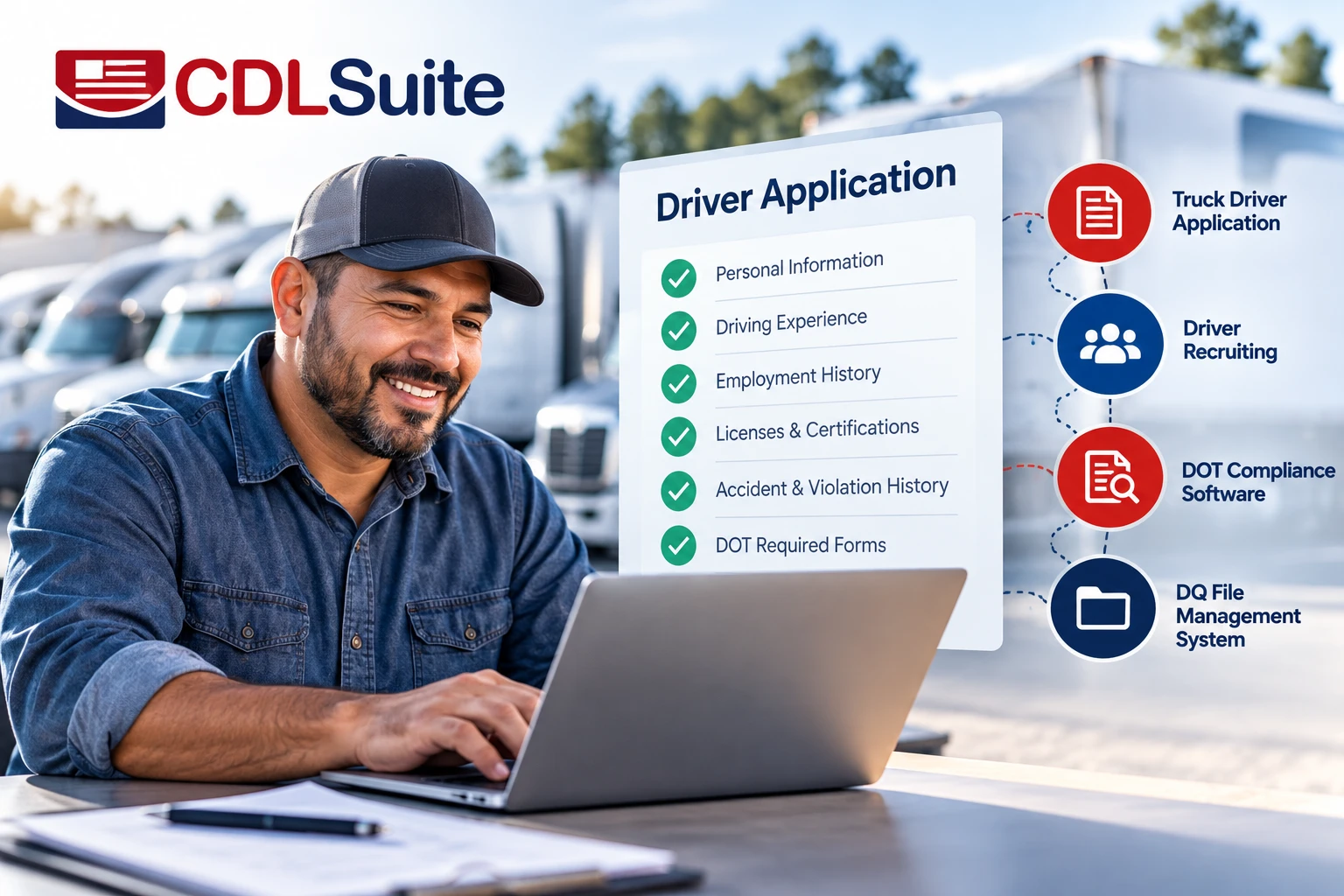
Hiring a commercial driver requires more than collecting a name, phone number, and work history. For employers subject to Department of Transportation requirements, the truck driver application is an important part of the compliance process and mistakes or missing information can create problems long after a driver is hired.
Unfortunately, many companies still manage driver applications using paper forms, fillable PDFs, email attachments, spreadsheets, and separate systems. What should be a straightforward hiring process can quickly become a time-consuming administrative task.
A better approach is to simplify the truck driver application from the beginning, making it easier for applicants to provide the right information and easier for your team to manage what comes next.
Start With Compliance
A standard employment application and a DOT-regulated driver application are not necessarily the same thing.
Depending on the position and applicable regulations, employers may need to collect detailed information about driving experience, employment history, licenses, accidents, traffic violations, and other information required as part of the driver qualification process.
Trying to collect missing information after an applicant has already moved further into the hiring process creates unnecessary work. A well-designed truck driver application should help collect the appropriate information from the beginning.
This is one reason organizations using a general HR application may benefit from a dedicated DOT compliance process for regulated drivers.
Eliminate Paper Processes
Paper applications may seem simple, but the work often begins after the applicant turns them in.
Someone may need to review the application for missing information, decipher handwriting, contact the applicant about incomplete fields, enter information into another system, scan documents, and determine where everything should be stored.
Electronic applications can eliminate much of this administrative work.
Applicants can enter their information directly into an online application, while required fields and electronic forms can help reduce incomplete submissions. Information can then move directly into the next stage of the hiring and qualification process instead of being manually reentered.
Simplify Driver Onboarding
The truck driver application should not operate as an isolated part of the hiring process.
Once an employer decides to move forward with an applicant, additional documents, authorizations, verifications, and qualification requirements may still need to be completed. Managing each of those steps separately can make driver recruiting and onboarding unnecessarily complicated.
An integrated process allows information collected during the application stage to continue with the applicant as they move toward becoming a hired driver. This reduces duplicate data entry and gives HR and safety personnel a clearer picture of what has been completed and what still requires attention.
Track What�s Missing
One of the biggest challenges in driver onboarding is determining what is still outstanding.
Did the driver complete the application? Has the required authorization been signed? Was the driver's license received? Is a document incomplete? Has a required verification been completed?
When those answers are spread across email inboxes, folders, spreadsheets, and filing cabinets, even a relatively small fleet can become difficult to manage.
A centralized checklist can make the process much easier by showing the status of required documents, forms, and verifications in one place. Instead of searching for information, your team can focus on resolving the items that actually need attention.
Connect Your Systems
Many companies already use an HRIS or other human resources platform to manage employees. That doesn't mean they should force a general HR system to handle every specialized DOT requirement.
A dedicated DOT compliance software platform can complement an existing HR system by handling the specialized application, onboarding, and driver qualification processes associated with regulated drivers.
When systems are integrated, organizations can reduce duplicate entry while allowing HR and safety teams to use tools designed for their respective responsibilities.
The goal isn't to add another layer of complexity. It's to connect the right tools so the overall process becomes simpler.
Build the DQ File
Hiring the driver isn't the end of the process.
Information and documentation collected during application and onboarding may ultimately become part of the driver's qualification records. Using a DQ file management system allows employers to transition from applicant to employee without starting over with a separate manual filing process.
Once the driver is hired, the organization can continue managing qualification documents, expiration dates, renewals, and other compliance requirements from a centralized system.
That creates continuity from the initial truck driver application through ongoing driver qualification management.
Use Automation Wisely
Technology can eliminate many repetitive administrative tasks, but automation works best when it makes the process easier rather than simply adding more technology.
Automated reminders can help identify expiring documents. Electronic forms can reduce paperwork. Digital checklists can make missing requirements easier to spot. AI-assisted document review can help identify potential issues that might otherwise require additional manual review.
But there will always be situations that require a person.
A driver may not understand what information is being requested. A safety manager may have a question about a document. An HR professional may need help determining how to configure a workflow.
The best technology simplifies routine work while making it easy to get human assistance when it is needed.
Make Compliance Easier
Simplifying your truck driver application isn't just about making the application itself shorter or faster. It is about simplifying the entire process surrounding it.
When applications, onboarding documents, qualification requirements, and DQ files are managed as part of one connected workflow, employers spend less time chasing paperwork and more time managing their drivers and their business.
CDL Suite was designed to help companies do exactly that.
From electronic DOT driver applications and onboarding to document tracking, DQ file management, expiration alerts, and ongoing compliance tools, CDL Suite brings the driver qualification process together in one easy-to-use platform.
You don't have to be a DOT compliance expert or manage compliance with a collection of spreadsheets and folders.
DOT Compliance Simplified.
Learn more about how CDL Suite can simplify your truck driver application, onboarding, and driver qualification process, or request a demonstration today.
Get started IN MINUTES
Starting at only $199.95 /month
Nothing to download or install. CDL Suite is web-based so there are never any compatibility issues. No need to purchase any hardware or software. Driver qualification file software could not be easier.
Get Started


